
AI ENGINEERING — Independent project
AI-Powered Peacebuilding Knowledge Assistant (RAG)
Context
In the Central African Republic, information relevant to peacebuilding actors is distributed across NGO reports, United Nations and MINUSCA publications, and documents produced through dialogue processes, including the 2015 Bangui National Forum. The project aims to make this corpus easier to query while preserving the traceability of the information used to generate each answer.
Summary
Multilingual documentary assistant (FR/EN) designed to retrieve information from a complex knowledge corpus and produce source-grounded answers with verifiable citations.
Contributions
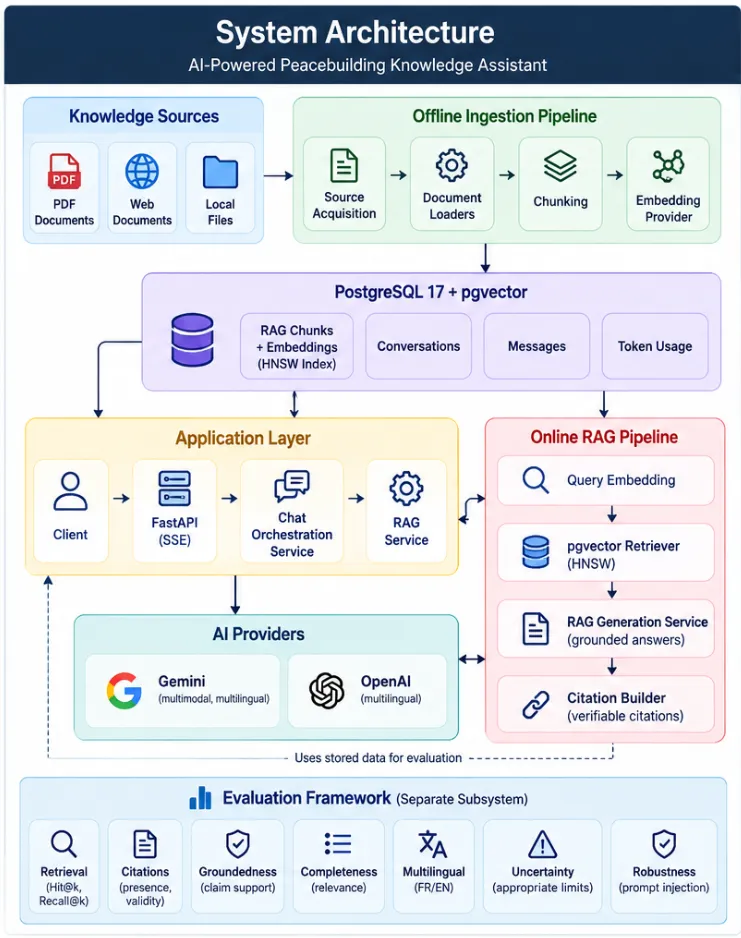
- RAG & AI Engineering: Designed the RAG pipeline: document ingestion, embeddings, PostgreSQL/pgvector retrieval with HNSW indexing, source-grounded generation with Gemini/OpenAI, uncertainty handling, and structured citations.
- Backend & Data: Built an asynchronous FastAPI/Pydantic API with SSE streaming, conversation and model-usage persistence, async SQLAlchemy, PostgreSQL, and Alembic migrations.
- Evaluation & Robustness: Implemented retrieval benchmarks (Hit@K, Recall@K, MRR), source faithfulness, citation, completeness/relevance, FR/EN consistency, uncertainty, and adversarial prompt-injection evaluations.
- Production Engineering: Built a modular LLM-provider-independent architecture with secure configuration, logging, health/readiness checks, Docker, Ruff, and 611 unit and integration tests validated from a clean clone.
Results
- Retrieval: Hit@20: 100% · Recall@20: 100% · MRR@20: 0.798 across 9 answerable benchmark cases.
- Source faithfulness: 85.7% claim-support accuracy across 7 cases, with 100% exact match for the identified supporting source.
- Completeness & relevance: 94.4% mean expected-concept coverage and 100% relevant answers across 9 evaluation cases.
- Citations: 100% citation presence and 100% structurally valid citations on the dedicated benchmark.
- FR/EN: Expected-source recall reached 100% in French and 100% in English across the evaluated multilingual cases.
- Software quality: 611 automated tests passed, with Ruff, migrations, FastAPI startup, PostgreSQL connectivity, and health/readiness also validated from a clean clone.
Value
- Verifiable information: Answers maintain an explicit connection to retrieved documentary passages so users can verify the supporting sources.
- Measurable quality: Evaluation separates retrieval, generation, citations, multilingual behavior, uncertainty, and robustness to identify regressions and improvement opportunities precisely.
- Evolvable architecture: Decoupling ingestion, embeddings, retrieval, generation, and LLM providers allows individual components to evolve without rewriting the entire system.
Technical stack
Python · FastAPI · Pydantic · PostgreSQL · pgvector · Gemini/OpenAI · Docker · Alembic · pytest · Ruff
System evaluation
Evaluation separates retrieval quality from generation quality. Hit@K, Recall@K, and MRR measure source retrieval, while dedicated evaluations cover faithfulness to retrieved passages, citation validity, completeness and relevance, uncertainty handling, and FR/EN consistency. These benchmarks use small, targeted evaluation sets to detect regressions and validate the architecture; they are not a guarantee of general system performance.
Production engineering
Environment-based configuration, Alembic migrations, failure logging at system boundaries, separate liveness and readiness endpoints, Docker containerization, and clean-clone release validation. The API image was reduced from approximately 1.16 GB to 559 MB by excluding development dependencies and artifacts from the runtime image.